Right to Work Checks in 2026: Everything Has Changed and Most Employers Have Not Caught Up
Ask an HR manager how confident they are about their right to work checking process and most will say very confident. Ask them to walk you through exactly what they do for an eVisa holder whose biometric residence permit has expired, and the confidence often evaporates.
The right to work checking landscape in the UK has changed dramatically over the past three years. The introduction of the eVisa system, the phasing out of biometric residence permits for most holders, and the introduction of HC 1691 have together created a compliance environment that is significantly more complex than the one most employers' processes were designed for.
This guide explains what the current rules require, where the most common mistakes occur, and how to build a checking process that will withstand UKVI scrutiny in 2026.
The Legal Framework
The obligation to conduct right to work checks sits in the Immigration, Asylum and Nationality Act 2006 as amended. The practical requirement is straightforward in principle: before employing someone, you must check that they have the right to work in the UK, and you must keep a record of that check in a form that gives you a statutory excuse against a civil penalty if the person is later found to be working illegally.
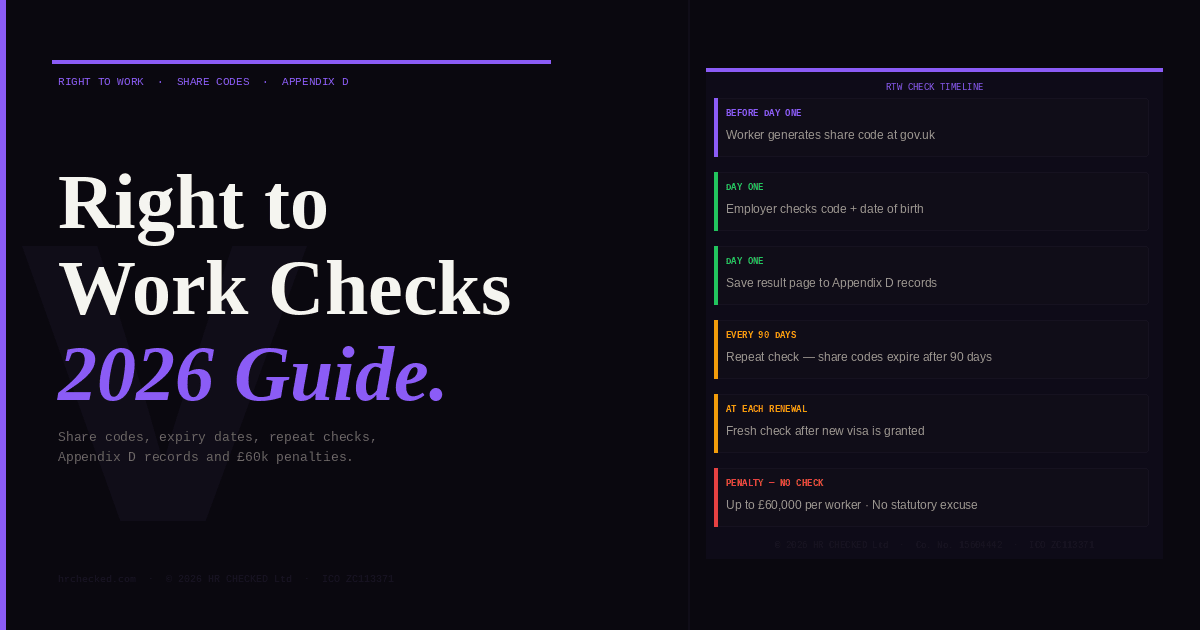
The maximum civil penalty for employing an illegal worker is currently £60,000 per worker. A statutory excuse — obtained by conducting the check correctly — protects you from that penalty even if the check was conducted in good faith and the worker's documents later proved to be fraudulent.
The key word is correctly. A check conducted incorrectly does not give you a statutory excuse, regardless of how it was done. This is where many employers fall down.
The Three Methods of Checking
There are currently three ways to conduct a compliant right to work check in the UK: the manual document check, the online right to work check via the Home Office Employer Checking Service, and the Identity Document Validation Technology (IDVT) check via a certified Identity Service Provider for British and Irish citizens.
Manual document checks
The manual check involves physically examining original documents from List A or List B of Schedule 3 of the Immigration, Asylum and Nationality Act 2006. List A documents give an unlimited right to work — British passport, EEA passport with settled status, indefinite leave to remain biometric residence permit. List B documents give a time-limited right to work and trigger a repeat check obligation.
The manual check process requires you to see the original document in person or via a live video call using the adjusted checking process. You must satisfy yourself that the document is genuine, that it belongs to the person presenting it, and that they are permitted to do the work you are offering. You must take a clear copy and retain it with a note of the date of the check.
Online checks for eVisa holders
This is where most employers are currently falling short. The vast majority of overseas nationals who previously held biometric residence permits have now transitioned or are transitioning to eVisas — a digital immigration status with no physical document.
An eVisa holder cannot present a physical document for a right to work check because they do not have one. The correct method is to use the Home Office online right to work checking service at gov.uk/view-right-to-work. The worker generates a share code from their UK Visas and Immigration online account, which they share with you. You enter the share code and the worker's date of birth into the checking service, which returns a result showing their right to work status.
The share code is valid for 90 days from generation. This means it will expire. A worker who generated their share code during their initial onboarding check may have an expired code months later when you need to conduct a repeat check. Building a process to manage share code expiry alongside visa expiry is essential.
IDVT checks for British and Irish citizens
Since April 2022, employers have been permitted to use certified Identity Document Validation Technology providers to conduct right to work checks for British and Irish citizens using a valid passport. This does not replace the need for a check — it provides a digital alternative to the manual check process for this specific category of worker.
Repeat Checks: The Timeline Problem
For workers on time-limited immigration status — Skilled Worker, Graduate, Student, and other temporary routes — you are required to conduct a repeat right to work check before the expiry of their current leave to remain. The purpose is to confirm that the worker's status has been extended or that they have obtained further leave before the previous grant expires.
The mechanics of managing repeat checks are where many employers' systems break down. A worker hired in January 2024 on a three-year Skilled Worker visa has a right to work expiry in January 2027. If no one is tracking that date, the repeat check simply does not happen.
For a sponsor, the consequences of missing a repeat check are worse than for an ordinary employer, because the failure will be visible to UKVI during a compliance visit and may constitute a breach of your sponsor duties separate from the civil penalty risk.
The HC 1691 Interaction
Right to work compliance and HC 1691 salary compliance are separate obligations, but they interact in important ways that sponsors need to understand.
A worker whose right to work expires — because their visa has expired and they have not yet received a decision on their extension application — is in a legally ambiguous position. The three-month gap rule provides some protection in specific circumstances, but it is not a universal safety net. Sponsors need to track visa expiry dates closely and initiate extension applications with sufficient lead time to avoid gaps.
Simultaneously, HC 1691 requires that every payslip for every sponsored worker independently meets the going rate floor for their SOC code. A worker who is in the process of extending their visa has not lost their right to work in most circumstances, but their employer still needs to ensure their salary remains compliant in every pay period throughout the extension process.
Managing both of these obligations simultaneously — visa expiry tracking, right to work re-checks, and monthly salary compliance — requires either a very robust manual process or software that automates the monitoring and alerts you when action is needed.
What a Compliant Process Looks Like
A compliant right to work checking process in 2026 has five components.
First, a pre-employment check for every new hire, conducted before the first day of work, using the correct method for the individual's immigration status.
Second, a document storage system that retains the check evidence — copy of document or share code check result, date of check, identity of the person who conducted it — for the duration of employment and for two years afterwards.
Third, a reminder system that tracks the expiry date of every time-limited permission and triggers a repeat check workflow at least two to three months before expiry.
Fourth, a process for handling the share code specifically — obtaining a fresh code from the worker, conducting the online check, and recording the result before the previous code expires.
Fifth, a connection between the right to work process and the payroll process, so that HC 1691 salary monitoring takes account of any changes to a worker's immigration status that might affect their eligibility to continue working.
Building This Process Without a Dedicated Immigration Team
Most small and medium sponsors do not have a dedicated immigration compliance function. The HR manager, the finance director, and the line manager share the compliance responsibility in an informal way that works well when everything is running smoothly and fails when someone is on leave or the company grows quickly.
The solution is not to hire a compliance specialist — it is to use software that enforces the process automatically. An automated system that tracks visa and right to work expiry dates, sends reminders at the right intervals, and stores check evidence in a structured format removes the dependence on individual knowledge and memory.
HR CHECKED provides exactly this infrastructure. Our platform tracks every sponsored worker's visa expiry and right to work expiry date, sends automated alerts at 90, 60, 30, 14, and 7 days before expiry, and maintains a digital record of every check conducted. Combined with monthly HC 1691 salary compliance monitoring, it gives sponsors a single system of record for the two most important compliance obligations they face.
You can try the platform free for 14 days at hrchecked.com. No credit card required.
This article is for general information only and does not constitute legal or immigration advice. For advice specific to your circumstances, consult a qualified immigration solicitor or OISC-registered adviser.