The A-Rating Is Not Given — It Is Maintained
There is a common misconception among newly licensed sponsors that the A-rating awarded when their licence is granted is a permanent status, like a qualification or a certificate that hangs on the wall. It is not. The A-rating is a live assessment of whether your organisation is meeting its sponsor duties on a continuous basis. UKVI can downgrade or revoke a licence at any point if compliance standards fall below the required level.
Understanding this is the foundation of everything else in this guide. The goal of compliance is not to pass a periodic inspection — it is to maintain a state of continuous compliance so that any inspection, announced or unannounced, finds exactly what the Home Office expects to find.
What UKVI Is Actually Looking For
When a UKVI compliance officer visits your premises, they are working through a structured assessment of your HR systems and processes against the duties set out in the sponsor guidance. The assessment has two broad dimensions.
The first dimension is record keeping. Do you have the documents you are required to hold? Are they complete, current, and organised in a way that can be audited efficiently? This covers right to work documentation, Appendix D records, CoS evidence, payslip records, and absence documentation.
The second dimension is monitoring and reporting. Are you tracking the things you are required to track — worker attendance, salary levels, contact information, visa expiry dates? Are you reporting changes to UKVI within the required timeframes? Is your Sponsorship Management System (SMS) accurate and up to date?
Sponsors who fail compliance visits almost always fail on one of these two dimensions. The failure is rarely dramatic — it is usually the slow drift of a process that was working when the licence was granted but has not kept pace with the growth of the sponsored workforce or the changes in the rules.
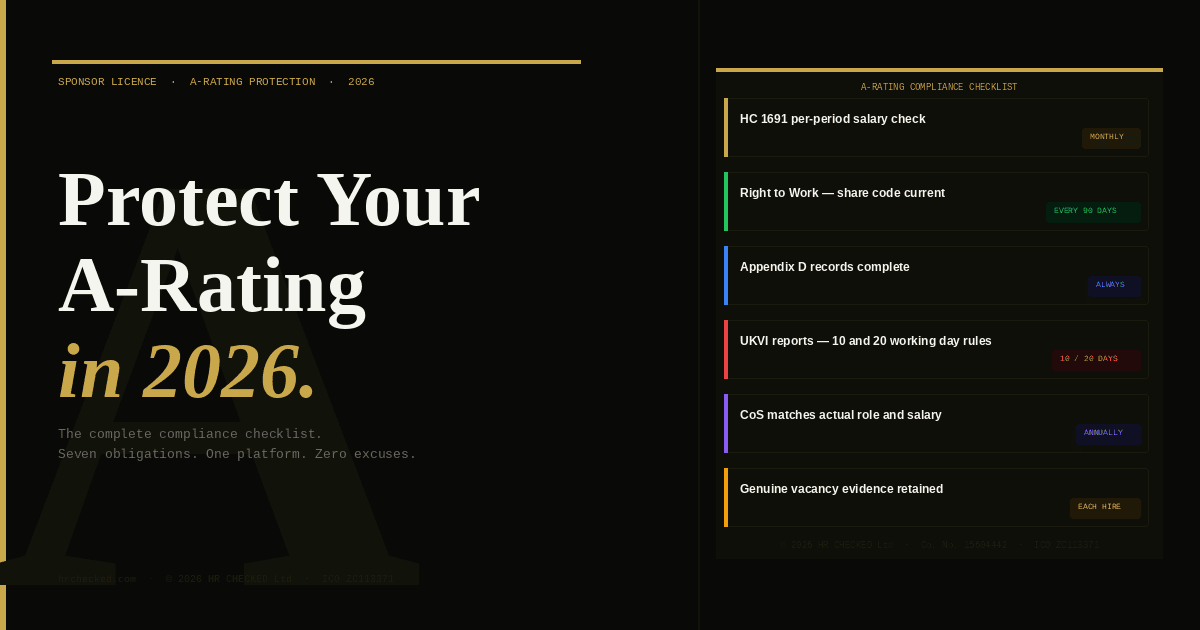
The Seven Compliance Obligations That Protect Your A-Rating
1. HC 1691 Per-Period Salary Compliance
This is the compliance obligation that has changed most significantly in 2026 and the one where the most sponsors are currently at risk without knowing it.
Before HC 1691 came into force in April 2026, salary compliance was assessed on an annual basis. As long as a worker's annual salary met the minimum threshold for their SOC code, the compliance obligation was met — even if individual months were lower due to absence, reduced hours, or variable pay.
HC 1691 ended this. Under the new rules, every individual pay period must independently meet the going rate floor for the worker's SOC code. There is no averaging. A worker whose monthly payslip falls below the going rate floor in any month — for any reason — has a non-compliant payslip for that month.
The going rate floor is calculated as the annual going rate for the SOC code divided by 12. For a software developer (SOC 2134) with a going rate of £52,500, the monthly floor is £4,375. A payslip showing £2,187 due to two weeks of unpaid leave is non-compliant, regardless of the worker's annual salary.
The practical implication is that salary compliance must be monitored monthly, not annually. Every payroll run is a compliance event. Any decision that affects a worker's monthly pay — approving unpaid leave, processing a salary sacrifice arrangement, varying hours — needs to be assessed against the HC 1691 floor before it is implemented, not after.
2. Right to Work Evidence — Current and Complete
Your right to work documentation must be current. This sounds obvious but the mechanics of keeping it current are where many sponsors fail.
For workers on time-limited visas — which covers the majority of sponsored workers — you are required to conduct a repeat right to work check before the expiry of their current leave to remain. The check must be conducted using the current correct method for the worker's immigration status: the online share code check for eVisa holders, the manual document check for those with physical leave to remain documentation.
A right to work check that was correct at onboarding becomes worthless if it has not been refreshed at the required intervals. UKVI officers will look at the date of your most recent check and compare it against the worker's current visa expiry.
3. Appendix D Records — Structured and Accessible
Appendix D of the sponsor guidance sets out the documents and records that sponsors must retain for each sponsored worker. The list is extensive: copies of passports and visas, right to work check evidence, employment contracts, payslips, absence records, contact information, and records of any changes to the worker's employment.
The most common Appendix D failure we see in compliance audits is not that records do not exist — it is that they are disorganised. They are spread across HR systems, email attachments, shared drives, and physical files. When a compliance officer asks for the Appendix D records for a specific worker, the employer cannot produce them efficiently.
The standard you should hold yourself to is this: if a compliance officer arrived unannounced this morning and asked for the complete Appendix D records for any worker in your sponsored workforce, could you produce them within 30 minutes? If the answer is no, your records are not compliant — even if every individual document exists somewhere.
4. UKVI Reporting — Within the Required Windows
Sponsors are required to report certain events to UKVI via the Sponsorship Management System within specific timeframes. The two most important windows are 10 working days and 20 working days.
The 10-working-day window applies to absences without permission of 10 or more consecutive working days. If a sponsored worker goes absent without authorisation and has not been in contact for 10 working days, you must report it.
The 20-working-day window applies to a broader range of events: a worker does not turn up for their first day of work, a worker's employment ends early, a worker's salary or working hours change materially, the worker is absent without pay for four or more weeks.
Missing these reporting windows is one of the fastest ways to damage your A-rating. It is also one of the most preventable failures — the events are known, the windows are fixed, and a simple reminder system would ensure nothing is missed.
5. CoS Accuracy — Role, Salary, and Location
The Certificate of Sponsorship is a legal statement about the worker's employment: the role they will perform, the salary they will receive, the location where they will work. UKVI treats the CoS as a binding commitment.
If anything on the CoS no longer accurately reflects the worker's actual employment — if their role has changed, their salary has been reduced, they are working from a different location — you may have a compliance obligation to notify UKVI and potentially to assign a new CoS.
The most common CoS accuracy failure we see is salary drift. A worker is sponsored at a salary that meets the going rate at the time of application. Over time, due to the annual increase in going rates or changes in the worker's role, the CoS salary no longer meets the current threshold. The employer does not notice because they are not monitoring going rates regularly.
6. Genuine Vacancy Evidence
The Home Office expects sponsors to be able to demonstrate that the roles they sponsor workers into are genuine — that they represent real employment needs, that the recruitment process was conducted fairly, and that the worker selected was the most suitable candidate.
This does not mean you need an elaborate paper trail for every hiring decision. It means you need to retain enough evidence to tell a coherent story: what the role was, where it was advertised, who applied, how you assessed candidates, and why you selected the sponsored worker.
7. Contact Information — Current for Every Worker
You are required to maintain current contact information for every sponsored worker: home address, personal email address, and telephone number. You must also have records that demonstrate you know where the worker is — that they are attending work as expected, or that you are aware of and have authorised any absence.
This obligation sounds trivial but it has real consequences. A compliance officer who asks for the contact details of a worker and receives information that turns out to be a previous address has identified a compliance failure. A sponsor who cannot account for the whereabouts of a sponsored worker has a more serious problem.
Building the Infrastructure That Protects Your Rating
The seven obligations above are not independent. They interact and reinforce each other. A robust approach to Appendix D records makes RTW repeat checks easier to track. Monthly HC 1691 monitoring catches salary drift before it becomes a CoS accuracy issue. Current contact information supports absence monitoring and UKVI reporting.
The sponsors who protect their A-ratings most effectively are not those who treat compliance as a set of discrete boxes to tick. They are those who build an integrated compliance infrastructure — a single system of record that connects HR, payroll, and immigration compliance in a coherent whole.
HR CHECKED was built to provide this infrastructure for UK sponsors. Our platform monitors HC 1691 salary compliance monthly across every sponsored worker, tracks visa and right to work expiry dates with automated alerts, and maintains a structured digital Appendix D record vault.
Start a free 14-day trial at hrchecked.com and see what your current compliance position looks like — before UKVI does.
This article is for general information only and does not constitute legal or immigration advice. For advice specific to your circumstances, consult a qualified immigration solicitor or OISC-registered adviser.