The Real Cost of Sponsoring an Overseas Worker in 2026
When employers calculate the cost of hiring an overseas worker, they almost always undercount. The salary is obvious. The visa fee is visible. But the Immigration Skills Charge — a levy paid by the sponsoring employer for every year of sponsorship — is frequently either forgotten entirely or modelled incorrectly, leading to budget surprises that can destabilise hiring plans midway through a recruitment process.
This guide gives you the complete picture: what the Immigration Skills Charge is, how it is calculated, what it sits alongside in the total cost of sponsorship, and how to reduce your exposure over time without cutting corners.
What Is the Immigration Skills Charge?
The Immigration Skills Charge (ISC) is a levy paid by licensed sponsors when they assign a Certificate of Sponsorship to a Skilled Worker visa applicant. The intention behind it — as stated in the Immigration Skills Charge Regulations 2017 — is to incentivise employers to invest in training and skills development for the resident workforce, rather than defaulting to overseas recruitment.
Whether it achieves that purpose is debated. What is not debated is that it represents a significant and predictable cost for sponsors, and one that has increased over time.
The charge applies per worker, per year of sponsorship. For most sponsors, the current rates are £1,000 per year for medium and large sponsors and £364 per year for small sponsors and charities. These figures are set by regulation and have been the subject of parliamentary debate in 2026 as part of the broader route reform discussions — always check the current rates on GOV.UK at the point of application, as they can change.
How the ISC Is Calculated in Practice
The ISC is charged for the full period of the Certificate of Sponsorship, rounded up to the nearest six months in some configurations. This means the calculation is not simply annual rate multiplied by years — you need to account for the exact duration of the CoS.
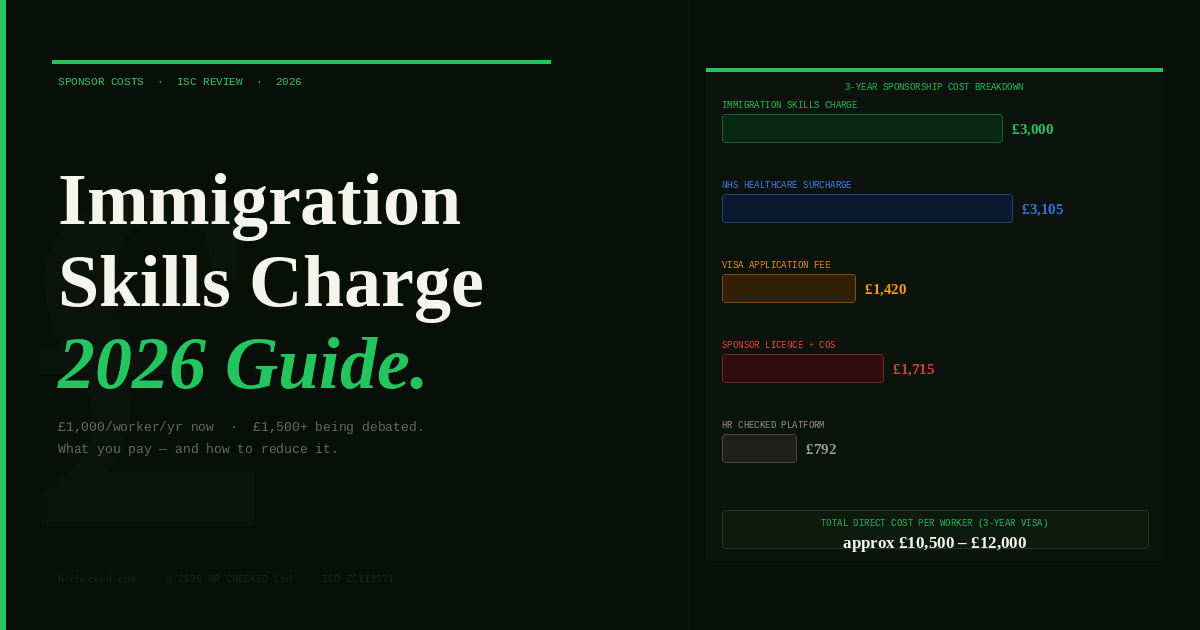
For a three-year Skilled Worker visa at the medium/large sponsor rate, the ISC would currently be £3,000. For a five-year visa, it would be £5,000. These figures are paid upfront at the point of CoS assignment — you cannot defer them.
For sponsors who hire regularly at scale, the cumulative ISC liability across a sponsored workforce can run to tens or hundreds of thousands of pounds per year. This is not a rounding error in the HR budget — it is a line item that deserves the same attention as payroll.
The Full Cost Stack
The ISC does not exist in isolation. It sits within a cost stack that, for a typical Skilled Worker hire, includes the following elements.
The Certificate of Sponsorship fee is currently £239 per CoS assigned. This is paid by the employer and is non-refundable regardless of whether the visa application succeeds.
The visa application fee is paid by the worker but is frequently covered or reimbursed by the employer as part of the hiring package. The current fee for a Skilled Worker visa of three years or less is £827; for more than three years it is £1,636. These figures apply to applications made outside the UK — in-country switching carries different fees.
The Immigration Health Surcharge is paid by the worker upfront for the entire visa period and covers NHS access during their stay. The current rate is £1,035 per year for adults — a five-year visa therefore attracts an IHS of £5,175. Many employers cover this cost as part of their relocation package, making it an employer cost in practice even though it is technically the applicant's liability.
Dependant costs apply separately for each family member accompanying the sponsored worker. Each dependant pays their own visa fee and IHS contribution. For a worker with a partner and two children on a five-year visa, the dependant costs alone can exceed £20,000.
The sponsor licence fee is a fixed cost spread across all your CoS assignments. The initial licence application costs £536 for small sponsors and £1,476 for medium and large sponsors. There is currently no renewal fee, but this has been the subject of policy discussion.
Why Sponsors Routinely Undercount
The most common reason employers undercount sponsorship costs is that they model the visa fee and forget everything else. The second most common reason is that they model the costs correctly for the initial hire but fail to account for the fact that sponsorship is not a one-off event.
Workers extend their visas. They change employers. They bring family members. They sometimes need to switch CoS if their role or salary changes materially. Each of these events can trigger additional costs — a new CoS fee, additional ISC for the extension period, updated visa fees.
The employers who manage sponsorship costs most effectively are those who build a total cost of ownership model that covers the entire expected tenure of each sponsored worker, including likely extensions and dependant scenarios.
Reducing ISC Exposure: What Works and What Does Not
There are lawful ways to reduce your Immigration Skills Charge exposure over time, and there are approaches that create compliance risk.
What works: investing in the resident workforce so that your dependency on overseas recruitment reduces over time. This is precisely what the ISC was designed to incentivise. Employers who build apprenticeship programmes, invest in training pipelines, and develop domestic talent genuinely reduce their long-run ISC liability.
What works: accurate role scoping before you assign a CoS. If you assign a CoS for a five-year period when a three-year visa would serve the business need, you have overpaid on ISC. Model the likely tenure carefully.
What works: retaining sponsored workers. The ISC is a fixed cost at the point of CoS assignment. If a worker leaves after six months and you need to sponsor a replacement, you pay the ISC again. High attrition in sponsored roles is expensive in ways that go well beyond lost productivity.
What does not work: structuring employment arrangements to avoid or reduce ISC liability through artificial means. UKVI takes a dim view of arrangements that appear designed to circumvent the charge, and the reputational and licence risk of getting this wrong far exceeds any short-term saving.
The Compliance Connection
There is a direct connection between ISC management and compliance management that is easy to miss. Employers who manage their sponsored workforce poorly — who lose track of visa expiries, who fail to maintain HC 1691-compliant payslips, who do not keep Appendix D records current — often end up paying the ISC multiple times for the same role because compliance failures trigger worker departures and replacement sponsorship.
Every compliance failure has a financial tail. A worker whose visa is curtailed because their employer failed a compliance check does not just represent a lost employee — they represent wasted ISC, wasted visa fees, and the cost of starting the sponsorship process again for their replacement.
This is why compliance investment pays for itself. Automated monthly HC 1691 salary checks, RTW expiry alerts, and digital Appendix D record keeping are not just risk management tools — they are cost management tools. Keeping the sponsored workers you have invested in recruiting and sponsoring is significantly cheaper than replacing them.
Planning for 2026 and Beyond
The ISC rate environment in 2026 is uncertain. Parliamentary debates have included discussion of both increasing the charge — as part of a broader effort to reduce net migration — and reforming it to be more directly linked to training investment. Either outcome could materially affect your forward cost model.
The prudent approach is to model your sponsored workforce costs with a range of ISC scenarios, maintain the compliance infrastructure needed to retain the workers you sponsor, and keep a watching brief on the fee regulations as they are updated.
HR CHECKED helps sponsors track the payroll and compliance data that underpins sustainable sponsorship. Our platform monitors HC 1691 salary compliance monthly, tracks RTW and visa expiry dates, and maintains the Appendix D records that protect your licence. Start a free 14-day trial at hrchecked.com.
This article is for general information only and does not constitute legal or immigration advice. Visa fees and ISC rates quoted are illustrative — always verify current figures on GOV.UK before making any application.