If you sponsor overseas workers on Skilled Worker visas, 8 April 2026 is a date that changes how you manage payroll compliance. HC 1691 — the latest Home Office Statement of Changes — introduced the most significant salary compliance rule in years: the per-period salary floor. This is not a small adjustment. It fundamentally changes how you must structure pay for every sponsored worker on your payroll. This guide explains exactly what HC 1691 requires, how the per-period rule works in practice, and what you must do right now to avoid a compliance breach that could cost you your sponsor licence.
What Is HC 1691? HC 1691 is the Statement of Changes to the Immigration Rules laid before Parliament and brought into force on 8 April 2026. Among several changes to UK immigration policy, it introduced a critical amendment to the salary requirements for Skilled Worker visa holders. The change targets a compliance gap that some sponsors — and inadvertently others—had exploited, where a worker's annual salary appeared to meet the going rate threshold, but their actual monthly or weekly pay fluctuated significantly below it due to bonus structures, unpaid leave, or irregular payment schedules.
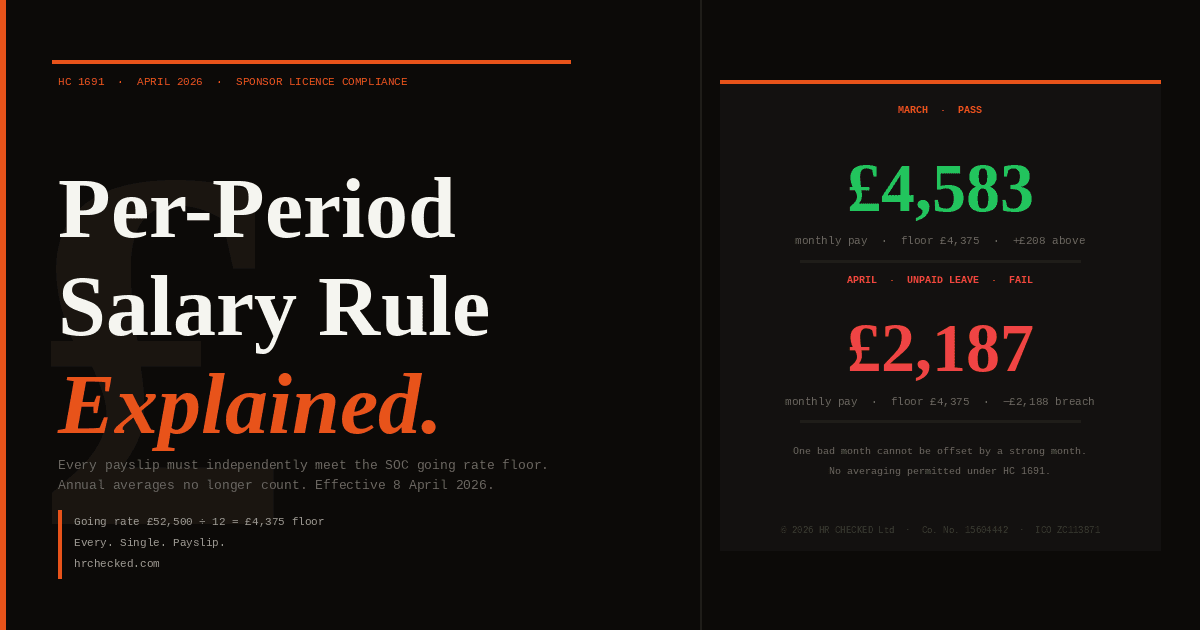
The Old Rule vs The New Rule Before 8 April 2026, compliance was assessed on an annualised basis. If a worker's CoS stated they would earn £52,500 per year (matching the SOC 2134 going rate for software developers), UKVI assessed compliance by looking at whether the annual total met the threshold. A month where the worker received only £2,000 because a bonus was deferred would not, by itself, trigger a compliance failure. From 8 April 2026, that changes completely. Under HC 1691, every individual pay period must independently meet the applicable going rate floor. The rule is calculated as: Monthly floor = Annual going rate ÷ 12 Weekly floor = Annual going rate ÷ 52 If a worker is paid monthly and their SOC going rate is £52,500, their monthly floor is £4,375. Every single payslip must meet or exceed £4,375. Not most months. Every month. There is no averaging. A strong month cannot compensate for a weak one. Bonuses paid in one period do not offset shortfalls in another.
Why Parliament Introduced This Change The change emerged from an extended parliamentary debate about salary manipulation in the sponsored worker system. Evidence presented to the Home Affairs Committee showed that some employers were meeting the annual going rate threshold on paper while paying workers significantly less in practice — using complex bonus structures, discretionary payments and deferred compensation to inflate the CoS figure without delivering it month to month. The 10 Route reform debates, which have dominated immigration discussion in Westminster throughout early 2026, have pushed the government to tighten every aspect of the Skilled Worker route. HC 1691's per-period rule is the salary enforcement arm of that broader tightening.
Who Does This Affect? HC 1691 applies to all sponsored workers on the Skilled Worker route from 8 April 2026, including: Workers sponsored before this date (there is no grandfathering) Workers currently employed under a valid CoS issued before April 2026 Workers due for visa renewal on or after this date If you have workers whose pay structure relies on quarterly bonuses, sales commissions, irregular overtime, or any deferred element to reach the annual going rate, you are at risk of a period-by-period breach from this date.
Calculating the Monthly Floor for Common SOC Codes Here are the per-period monthly floors for the most commonly sponsored roles in the UK: SOC Code Occupation Annual Going Rate Monthly Floor 2134 Programmers and software developers £52,500 £4,375 2131 IT project managers £55,000 £4,583 2135 Cyber security professionals £55,000 £4,583 2211 Medical practitioners (GPs) £62,000 £5,167 2231 Nurses £35,392 £2,949 3556 Sales accounts and BDM managers £55,200 £4,600 2421 Chartered accountants £47,300 £3,942 2412 Solicitors and lawyers £52,500 £4,375 1136 HR managers and directors £48,600 £4,050
The Most Common Scenarios That Will Cause a Breach
- Unpaid leave in a monthly pay period A worker on SOC 2134 (monthly floor £4,375) takes two weeks of unpaid leave. Their March payslip shows £2,187. That period fails the HC 1691 check — regardless of what the annual total looks like. Solution: Before approving unpaid leave for any sponsored worker, calculate whether the reduced payslip will still clear the monthly floor. If it will not, restructure the leave or use alternative arrangements.
- Commission-heavy or bonus-dependent roles A sales professional on SOC 3556 has a base salary of £24,000 plus commission. Their target total compensation is £60,000 but their base monthly salary is only £2,000. In any month where commission is not paid, they fail the per-period floor of £4,600. Solution: The base salary on the CoS — not the total compensation package — must meet the per-period floor in every pay period. If the base does not achieve this, the CoS must be updated.
- Salary sacrifice arrangements Workers who have entered into salary sacrifice for pension, childcare vouchers or cycle-to-work schemes may see their gross pay reduced below the floor. HC 1691 assesses the payment actually made in the period, not the notional salary before sacrifice. Solution: Check every sponsored worker's salary sacrifice arrangements and ensure gross pay after sacrifice still meets the monthly floor in every period.
- Part-month starts and terminations A worker starts on the 15th of the month. Their payslip for that first month shows only half a month's salary — £2,100. For SOC 2134 that is below the £4,375 floor. Solution: The per-period rule is calculated pro-rata for partial periods. The floor for a half-month starting on the 15th is £4,375 ÷ 2 = £2,187.50. Ensure even pro-rated start and finish months meet the proportionate floor.
What UKVI Will Look For During a Compliance Visit If UKVI conducts a compliance visit after 8 April 2026, inspectors will now request payslips — not just CoS documents and annual salary confirmations. They will check each payslip against the applicable monthly floor for the worker's SOC code. Under the updated Appendix D requirements, you must retain: Every payslip for every sponsored worker A record of the SOC going rate applicable to each worker at the time of each pay period Evidence of any pro-rata calculations for partial months An audit log demonstrating that your payroll was checked against HC 1691 requirements each period The civil penalty for illegal working remains up to £60,000 per worker. A pattern of per-period breaches, even if inadvertent, can support a finding of non-compliance sufficient to trigger a sponsor licence suspension or revocation.
The 10 Route Reform Context HC 1691 does not exist in isolation. It is part of a broader government programme to reform what ministers have called the "10 Routes" through which people can legally remain in the UK. Parliamentary debate in early 2026 focused heavily on ensuring that legal routes — including the Skilled Worker route — operate with robust salary floors that cannot be gamed. The per-period rule is the direct legislative outcome of that debate. Further changes are expected before the end of 2026, including potential adjustments to the new entrant rate (currently at 70% of the going rate for eligible workers) and additional reporting requirements for sponsors in certain sectors.
How to Audit Your Payroll for HC 1691 Compliance Today Follow these steps immediately: Step 1: List every sponsored worker and their SOC code. Check the current going rate for each SOC code at gov.uk or use the HR CHECKED SOC Salary Checker. Step 2: Calculate the monthly floor for each worker (going rate ÷ 12). Step 3: Pull the last six months of payslips for each worker. Check every payslip against their individual monthly floor. Step 4: Identify any periods where the payslip falls below the floor. For each identified breach, assess whether it was caused by unpaid leave, bonus structure, salary sacrifice, or a genuine payroll error. Step 5: Correct the root cause. If a worker's base salary is structurally below the monthly floor, the CoS must be updated and potentially reissued before the next pay period. Step 6: Implement a monthly check process. Every time payroll runs, someone in your HR or finance team must verify each sponsored worker's payslip against their HC 1691 floor before the payroll is finalised.
Automate HC 1691 Compliance with HR CHECKED Manually checking every payslip every month for every sponsored worker is time-consuming and error-prone. HR CHECKED automates this entirely. Our platform automatically checks each worker's pay period against their SOC going-rate floor. If a payslip is going to breach the HC 1691 floor, HR CHECKED flags it before the payroll is run — not after. You get a real-time compliance dashboard showing which workers are at risk and exactly what needs to change. The platform also maintains the complete Appendix D audit trail UKVI will request during a compliance visit: every payslip, every SOC going rate used, every HC 1691 check result, all timestamped and exportable in one click. Start your 14-day free trial at hrchecked.com — no credit card required.
Summary: What HC 1691 Means for You Every payslip must now independently meet the SOC going rate monthly floor There is no averaging — a good month cannot compensate for a bad one This applies to all sponsored workers from 8 April 2026, including those sponsored before this date Commission structures, unpaid leave and salary sacrifice all create HC 1691 risk UKVI will check payslips during compliance visits You must retain full payslip records as part of your Appendix D obligations The per-period rule is the most operationally significant compliance change for UK sponsors in years. Act now rather than waiting for a UKVI visit to discover the problem.