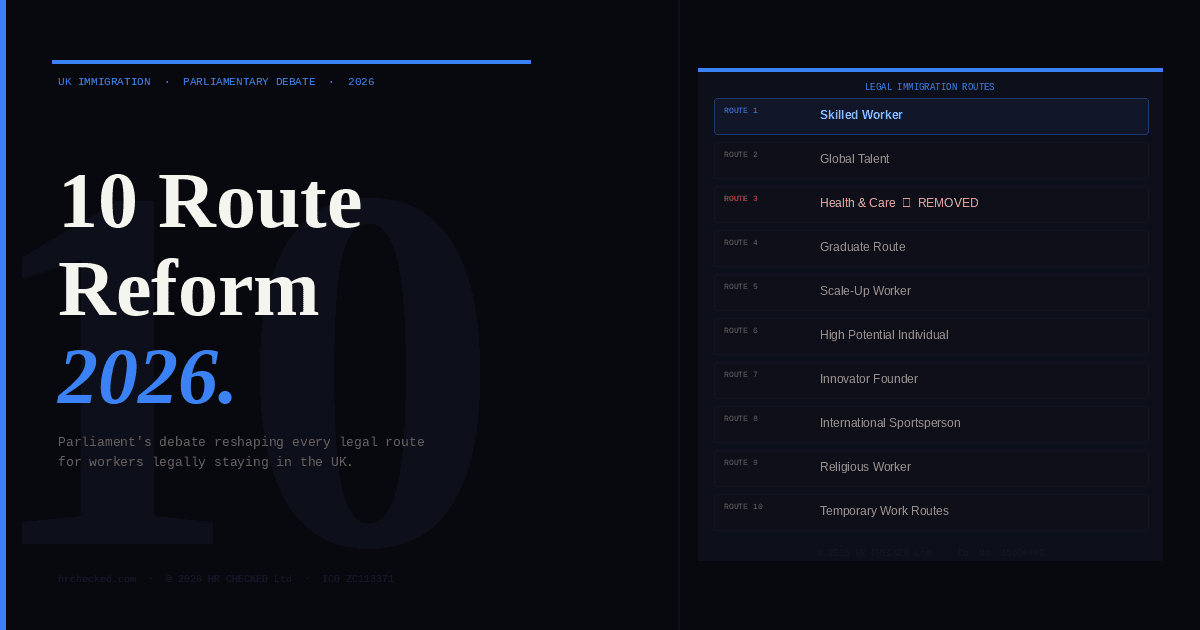
Why the 10-Route Reform Debate Matters for Every UK Sponsor
If you have been following UK immigration news in 2026, you will have noticed a pattern. Parliamentary debates, Home Office statements, and think-tank reports keep returning to the same theme: the architecture of the UK's work immigration system needs rebuilding, not just patching.
The phrase "10 route reform" has emerged from this debate as shorthand for a broader ambition — to rationalise, simplify, and in some cases tighten the routes through which overseas workers can lawfully live and work in the UK. For licensed sponsors, this matters not as an abstract policy question but as a practical planning challenge: the rules governing who you can hire, on what terms, and at what cost are shifting.
This guide explains what is being debated, how it affects each of the ten major work routes, and what you should be doing right now to protect your sponsor licence.
The Ten Routes: What Each One Is and What Is Changing
1. Skilled Worker Route
The Skilled Worker route is the backbone of the UK's employer-led immigration system. It accounts for the majority of work visas issued each year and is the route that most licensed sponsors use day to day.
The reform debate around Skilled Worker has focused on three areas. First, salary thresholds — HC 1691 introduced the per-period salary floor in April 2026, fundamentally changing how compliance is measured. Second, the shortage occupation list — the list of roles that qualify for a reduced salary threshold has been significantly curtailed, meaning fewer roles now benefit from the discount. Third, the genuine vacancy requirement — the Home Office has signalled that it will scrutinise CoS assignments more carefully to ensure employers are not using the route to fill roles that could be filled domestically.
For sponsors, the practical implication is that the Skilled Worker route is becoming more demanding, not less. The era of treating it as a straightforward administrative process is over.
2. Global Talent Route
The Global Talent route sits outside the standard sponsorship framework — workers on this route do not need a sponsor. Instead, they are endorsed by a designated competent body in their field: the British Academy, Royal Society, Royal Academy of Engineering, UK Research and Innovation, Arts Council England, or Tech Nation.
Reform discussions have focused on expanding the list of eligible fields and making the endorsement process more accessible. For employers, the relevance is indirect but real: the Global Talent route is increasingly used by the kind of highly skilled individuals — researchers, senior technologists, creative leaders — who might otherwise come through Skilled Worker. Understanding who in your prospective talent pool might qualify for Global Talent can save you sponsorship costs and administrative burden.
3. Health and Care Route
No work route has seen more turbulent reform discussion than Health and Care. The route was created to address workforce shortages in the NHS and social care sector, and it succeeded — perhaps too well. The volume of Health and Care visas issued in 2023 and 2024 contributed to net migration figures that became politically significant, leading to a series of restrictions.
The most significant changes introduced in recent years include restrictions on dependants for overseas care workers, tighter requirements around Care Quality Commission registration for care providers, and enhanced scrutiny of the labour market test. For Health and Care sponsors, the compliance environment is now among the most demanding in the system, and the consequences of getting it wrong — licence revocation, civil penalties, reputational damage — are severe.
4. Graduate Route
The Graduate route allows international students who have completed a UK degree to remain in the country for two years (three years for doctoral graduates) to work or look for work. It does not require sponsorship.
Reform discussions have been significant and ongoing. Critics argue the route contributes to net migration without a sufficiently strong link to employer demand. Defenders point to the economic contribution of international graduates and the risk of damaging the UK's attractiveness as a study destination.
For employers, the Graduate route is an important talent pipeline — particularly for early-career roles. The uncertainty around its future means employers who rely heavily on Graduate route workers should be scenario-planning: what happens to your recruitment strategy if the route is curtailed or time-limited further?
5. Scale-up Worker Route
The Scale-up route was designed for high-growth businesses that need to bring in talent quickly without the full sponsorship overhead. Workers on this route need a sponsor for their initial six months, after which they can work for any employer.
Take-up has been lower than anticipated, partly because the eligibility criteria for employers are demanding and partly because the route's flexibility — attractive in theory — creates complexity in practice. Reform discussions have focused on whether the route is achieving its purpose and whether adjustments to the eligibility criteria would make it more useful.
6. High Potential Individual Route
The High Potential Individual route targets graduates of top-ranked overseas universities who want to work in the UK without a job offer. It is time-limited — two years for bachelor's and master's graduates, three years for PhD holders — and does not require sponsorship.
The route is relatively small in volume but strategically important for employers who want to attract globally mobile talent early in their careers. Reform discussions have centred on the list of eligible universities and whether the route is genuinely bringing in the high-potential individuals it was designed for.
7. Innovator Founder Route
The Innovator Founder route replaced the Tier 1 Entrepreneur route. It targets people who want to set up and run innovative businesses in the UK, with endorsement from an approved endorsing body.
For most licensed sponsors, this route is not directly relevant — it is for founders, not employees. But for HR professionals in startup and scale-up environments, understanding the route matters because some of your senior hires or prospective co-founders may be using it.
8. International Sportsperson Route
The International Sportsperson route covers elite athletes and coaches who want to work in the UK for a UK-based sports organisation. It requires an endorsement from the relevant governing body.
Reform discussions have been relatively limited compared to the higher-volume routes, but the general direction — tighter evidence requirements, greater scrutiny of genuineness — applies here too.
9. Religious Worker Route
The Religious Worker route allows overseas nationals to come to the UK to work for a religious organisation in a non-pastoral role. It requires sponsorship by the religious organisation.
This is a niche route in terms of volume but operationally significant for the organisations that use it. The compliance requirements are the same as other sponsored routes — RTW checks, Appendix D records, salary monitoring — and the consequences of non-compliance are equally serious.
10. Temporary Work Routes
The temporary work routes — including Seasonal Worker, Creative Worker, Charity Worker, and Government Authorised Exchange — serve specific sectors and purposes. The Seasonal Worker route in particular has been the subject of significant policy attention given its role in addressing agricultural labour shortages.
Reform discussions have focused on whether the temporary routes are being used as intended and whether they provide adequate protections for workers.
What the Reform Debate Means in Practice
Across all ten routes, the direction of reform in 2026 is consistent: the Home Office wants fewer, better-quality applications; more robust compliance; and clearer accountability for sponsors.
For licensed sponsors, this means three things.
First, your internal processes need to be as good as your external commitments. If your CoS says a worker is doing one job at one salary and your payroll shows something different, that discrepancy will be found — either by UKVI directly or through the HC 1691 monitoring framework.
Second, the genuine vacancy requirement is being taken more seriously. Keep your recruitment records. Document why the role exists, what you advertised, who you considered, and why you selected the worker you sponsored. This is evidence you may need to produce at short notice.
Third, salary compliance is now a monthly discipline, not an annual review. HC 1691 means every payslip matters. A worker who takes unpaid leave, receives a reduced payment due to absence, or has a salary sacrifice arrangement that pushes them below the going rate floor in any given month has a non-compliant payslip for that month — regardless of their annual salary.
Protecting Your Sponsor Licence Through Reform
The sponsors who come through periods of route reform in the best position are not necessarily the ones with the largest HR teams. They are the ones with systematic processes that produce consistent evidence regardless of who is doing the work on any given day.
Automated RTW expiry alerts mean you do not miss re-check deadlines. Monthly HC 1691 payslip checks mean you identify salary compliance issues before UKVI does. Digital Appendix D records mean you can produce evidence within hours, not days.
HR CHECKED was built specifically for this environment. If you want to see how automated compliance monitoring works in practice, our free HC 1691 checker at hrchecked.com/hc1691-checker lets you check any worker's salary against the going rate floor instantly — no sign-up required. The full platform is available on a 14-day free trial at hrchecked.com.
This article is for general information only and does not constitute legal or immigration advice. For advice specific to your circumstances, consult a qualified immigration solicitor or OISC-registered adviser.